Showing posts with label Innovation. Show all posts

Thursday, November 15, 2012

Sex is thicker than Blood

It has been a very hectic schedule for me these past few weeks preparing for the competition at the Social Innovation Camp Asia held in Kuala Lumpur, Malaysia last 9-11 November 2012. My entry, the Blood Donors Network was selected among the top 6 finalists out of 140 ideas submitted across Asia. Just to share with you the result based from the judges' scorecard and an email validation from the organizers that the Blood Donors Network came out 2nd place from the recently concluded Social Innovation Camp Asia. The top prize went to the sex education app from Malaysia. Borrowing the quote from my long-time friend Neil Magno, it appears that "sex is much thicker than blood"... nice one Neil!

I would like to thank you for all the support by answering the poll question as part of my market validation that I sent through SMS, Facebook, G+, and face-to-face interview as well as by liking the Facebook app (https://www.facebook.com/BloodDonorsNetwork) which has already grown to more than a hundred members in more than 8 cities across Asia since its inception last November 11. 

Like what I have said from my first post, it was a humbling experience for me at the Social Innovation Camp Asia. I got goosebumps myself meeting these brilliant people across Asia unselfishly contributing their time and talent to support a worthy cause. Not everyone would have this opportunity and with that, I am very grateful with the said experience. I deeply appreciated the support and efforts that my team poured into, to make the idea happen in just one weekend, from outlining the business model up to the execution of both the web and mobile app prototypes. There are now plans to roll-out the idea in the Asia region within the next six months with the help of our team members, in Malaysia, Thailand, Cambodia, India, and Singapore. 

Allow me to take this opportunity to thank all the people who gave their support on this project.

The Blood Donors Network Team:
Gerard Navarro, Ronald Paglinawan, Bernard Hor, Sokha Rum, Adeline See, Kristine Lauria, Singaravelan Thirugnanasambandan, Sunit Shresta, Chow Yee Hoong, Krittika Kaewmamuang, and Tao Lin.

Dr. Ernesto Datu, Dra. Ann Claire Reyta, Dr. Norris Bin Naim, Dr. Serafin Talisayon, Prof. Edison Cruz, Prof. Glen Imbang, Andrew Tan, Randie Ongoco, Jay Fajardo, Jo Ann Barquez, Rose Aguilar, Noe Palaña, Jeremie Diaz, Christine Caro, Rina Santos, Ces dela Cruz, Joey Mendiola, Mark Alburo, Jong Aguilar, Terence Guillermo, Ahmira Shih, Grace Lado, Mario Vallo, Jennybeth Paglinawan, John Honrade, Danie Sedilla, Raffy Concepcion, Pasky Doria, Janice Florentin, Bong Cuevas, Sheena Pestaño, Ria Ricafort, Rod Nepomuceno, Lawrence Jatayna, Dulce Punzalan, Gabriel Abatay, Karen Kay Sia, Paul Abela, Juancho Atinaja, Corinne Dulce, Gerald Foronda, Jhensen Norberte, Ramil Compio, Kat Pauso, Bea Bacala, Marianne de Vera, Charissa Magalong, Neil Magno, Earl Valencia, Maan Asuncion, Joanna Domingo, JP Catalan, Sarah Lumang, Mickey Acevedo, Edison Lucmayon, Lot Eligio, Ned Legaspi, Reuben Romulo, Rochelle de Leon, Mark Gaan, Erick Payawal, Israel Rigonan, Karl Vidad, Pam Castillo, Vince Gonzales, Jun Ballesteros, Jesli Gloria, Alvin Selfaison, Fred Ferraz, Carlo Doran, Ruby Edralin, Roma Escaner, Vanz Kristian Lavado, Kat Salazar, Paolo Mandingiado, Jonathan Lansangan, Rex Sueno, Consha Tangco, Alec Leido, Leonardo Dapdap, Karol Atotubo, Gonz Gonzales, Romeo Duyag, Sheena dela Cruz, Romz Jaravata, Danielle Irma Arellano, Kelil Albuainain, Virgil Corcuera, Erlyn Gatchalian, Stefan Leido, Graciel Vergara, Dulce D' Bayan, Bong Edralin, Ting Gaddi, Judylyn Martinez, Bel Acosta, Julius Legaspi, Len Mungcal, Rodney Catorce, Emman Hernandez, Nim Gonzales, Tina Olpoc, Cheena Pagkaliwangan, Stephen Co, Bee Casillan, Solace Aguilar, Melissa Jones, Prince Karl Bagaforo, Allan Claveria, Thomas Detoito, Gabriella Germino, Justin Gonzales, Nigel Gosiaco, Klharina Hagos, Michael Garrovillo, Paul Pajo, Nick Wilwayco, and Michael Villasor.

To my wife Florence, Maggie, Mikko and my Mom. 

In front of the famous Petronas Tower
L-R: Ken Chester Wu of Bookbag (formerly Booklat), myself,
Gerard Navarro (UI Designer), and Ronald Paglinawan (iOS Developer)
Ruemz Hotel inside Taylor's Lakeside University
where we stayed on the entire duration of the competition
The Social Innovation Camp Asia was held
at Taylor's Lakeside University

Wednesday, November 14, 2012

The Blood Donors Network at the Social Innovation Camp Asia

The Social Innovation Camp was founded on the principle that The Internet, over the past fifteen years, has fundamentally changed the way we do things: from publishing and the arts to supply chains and business methods, our world has changed. We have not yet, however, seen these kinds of fundamental shifts in the way we address social problems.

The solution is to find people understand social problems at a deep level - from professionals to those with the deepest personal experience of those problems - and bring them together with those who understand technology at its most profound: software developers, designers, and service designers.

The Social Innovation Camp was set up in London, in early 2008 and the first in Asia held in Kuala Lumpur, Malaysia last November 9-11, 2012. Only six were selected out of 140 ideas across Asia, that is 4% acceptance rate, making it harder to get into the Social Innovation Camp compared to Harvard.

The Blood Donors Network was among the top six selected and is a reflection of my personal advocacy to promote regular blood donations in the Philippines. I myself is a blood donor for the past ten years and perceived that there should be a system to improve the supply of blood all year round in the country. Based from my personal experience, back in December 1997, I was afflicted with dengue fever and was confined at St. Lukes Hospital. The doctor informed me that my platelet count had dropped to critical level and need blood transfusion. However, the blood supply in the blood bank was, unfortunately low. The doctor told my relatives to call as many people as they could who would be willing to donate blood. And as expected, they called for help to as many people as they could. 

This personal experience happens everyday to a lot of people. A never ending scenario that every time someone needs blood, a call for help is always the immediate response. A news article from Philstar.com dated 16 August 2011 states that a dengue patient usually needs 16 units of blood. On that same article, the Philippine Red Cross had reported that there were 125,000 dengue cases in 2010. That turns out to be 2 million blood units that they need for dengue alone not counting the other cases, such as accident victims, premature babies, patients undergoing major surgeries, those suffering from trauma, anemia, cancer patients undergoing chemotherapy, so on and so forth. Whereas, on the average, the PRC collected only 6,000 units of blood per year, thus this clearly shows that the supply cannot keep up with the demand. Based from my interview with Dr. Reyta from the Philippine Red Cross, on the average, there are 5 to 7 patients every minute who would be needing blood transfusion.  
A screenshot from Philstar.com dated 16 August 2011

The Blood Donors Network team have identified three focus areas in order to solve the problem with validations during the interview from the doctors in Malaysia and the Philippines; 1) increase acquisition of new blood donors; 2) increase retention rate of existing blood donors, and 3) establish a comprehensive data of donors. 

Thus, the Blood Donors Network platform would be based in web and mobile apps that would address the said core issues. This way, the voluntary donors would allow to register themselves into the community of blood donors. For the recipient, it could post the blood type request that they need through the Blood Donors Network mobile app which would be able to connect to the community of blood donors, geo-location based via SMS as well as an option to send through Facebook or Twitter. 

It was a humbling experience at the Social Innovation Camp Asia. I got goosebumps when I met these brilliant people across Asia unselfishly contributing their time and talent to support a worthy cause. Not everyone would have this opportunity and with that, I am very grateful with the said experience. I deeply appreciated the support and efforts that my team poured into, to make the idea happen in just one weekend, from creating the business model up to the execution of both the web and mobile app prototypes. I was also amazed with the organizers of the Social Innovation Camp Asia that they were able to pull the event off with such a very lean team. 

Here in the Philippines, the team would have meetings with telcos, corporations and hospitals for possible partnerships to be able to beta test the business model and the prototype for the next six months. We are also planning to roll-out the idea in the Asia region with the help of our team members in Malaysia, Thailand, Cambodia, India and Singapore. Our Facebook app (https://www.facebook.com/BloodDonorsNetwork) have growing members in more than 8 cities across Asia since its inception last November 11. With these developments, the team will persevere with what they have started at the Social Innovation Camp Asia carrying along with that fundamental objectives in mind, to be able to promote healthy lifestyle, foster good deed, encourage the spirit of volunteerism, help a stranger, and more importantly, save someone's life.

Meet the top 6
From left to right: Andrew Tan (organizer of the Social Innovation Camp Asia), Chan Wai Jhet (Civic Ticket; Malaysia), Caryn Kong (LabRat; Malaysia), Wong Chee Yan (Sex Education in Mobile Apps; Malaysia), Joel Barquez (Blood Donors Network; Philippines), Amy Tan (Find Art; Singapore), and Ken Chester Wu (Booklat; Philippines).
Creating the Business Model
Aside from the prototype development, the business model is also drawn out for sustainability as this is the nucleus of the whole activity where you could attract funding from the venture capitalists and angel investors.  
The Blood Donors Network team
From left to right: Tao Lin (China), Singaravelan Thirugnanasambandan (India), Krittika Kaewmamuang (Thailand), Sokha Rum (Cambodia), Joel Barquez (Philippines), Bernard Hor (Malaysia), Kristine Lauria (Singapore), Gerard Navarro (Philippines), Adeline See (Malaysia), Ronald Paglinawan (Philippines), and Chow Yee Hoong (Malaysia).

One more thing...

The Blood Donors Network came in 2nd place at the recently concluded Social Innovation Camp Asia. Thank you very much for all the support.

Thursday, October 25, 2012

Blood Donors Network Among the Top 6

The idea, Blood Donors Network that was submitted at the Social Innovation Camp Asia last October 11, was among the six finalists selected out of 140 ideas across Asia. We will compete in Kuala Lumpur, Malaysia this coming November 9 to 11, 2012 to build on our mobile app for 48 hours. The venue is at Taylor's University Lakeside Campus.

Thank you very much for your support.

Taken from the Asia Social Innovation Camp website

Tuesday, July 3, 2012

Non-Technological Innovations

Introducing something new to the organization can be called innovation whether it is technological or non-technological where the end result should generally be for its advantage, that is, beneficial for the growth of the company. Yet, an organization should strive to lead the technological as well as non-technological innovation, to set the standard through continuous research and development, because once a dominant design or service is established in the market by another company, it will be too late for a company to set a different industry standard based on its own product or service. Any organization, once it loses its “innovative being”, may be reduced to a mere follower and may have a hard time regain its market leadership where it has previously been.

We have witnessed this in the Nokia mobile phone where it misses the opportunity to maintain its leadership in the market. Nokia merely developed incremental innovations on their devices, perhaps enjoying its market leadership, until the arrival of the Apple iOS that introduced a much radical design, has changed the mobile phone game ever since. Thus, to be able to survive the intense competition with Apple and other players like Samsung in the handset business, Nokia announced their alliance with Microsoft last February 2011, a business restructure innovation, in order to produce a line of smartphones called Lumia running the Windows operating system. Nokia have to use this strategy to regain its leading position in the marketplace. Yet, the market pull for the Window-based handset is dismal and made a negative effect on the organization. Recently, Nokia has announced that they need to slash 10,000 jobs, or 19 percent of its workforce, and the shutdowns of research and development center in Ulm, Germany, and Burnaby, Canada, and a handset factory in Salo, Finland, in order to save at least €1.6 billion or Ph₱53 billion, by the end of 2013.

A change in the business process or management to reduce cost is an approach that could also be regarded as non-technological innovation as in the case of Nokia. Yet, management innovation does not only pertains to slashing of workforce and facilities or restructuring its business organizational process. It may also apply to new ways of managing people, creating incentives, measuring performance, creating positive cultures, hiring, and leadership. All of these are distinctly human, and less about technology. Companies are great not only because they are at the leading edge of technological innovation but also have the people skill, introducing non-technological innovation in the organization that would give importance in the workforce, making people happy.

Another innovation approach is to rely on complementary assets, such as name recognition, to increase market share. To mention some, “to Google” is almost synonymous with “to search something in the web”, Amazon on the other hand, for online retail, and Colgate for toothpaste. These companies thrived on their brand names in order to become leaders in their respective markets.

According to BrandZ Top 100 Most Valuable Global Brands in 2012, Google brand alone costs US$107,857 million, Amazon costs US$34,077 million, and Colgate costs US$14,948 million. The top 1 brand is Apple at US$182,951 million, followed by IBM at US$115,985 million and Google at third. These companies in the top 3 are all in the technology industry, yet McDonalds which is in the fast food business was able to make it at the top 4 at US$95,188 million.

For the past years, we have seen McDonalds introduced new ways in marketing such as updated regional slogans, as “I’m lovin‘ it” in the US while “Love ko ‘to” in the Philippines, and improved customer service not only in the expansion on their menu, which is a product development innovation, in response to changing consumer taste, but also the redesign of all its restaurants worldwide, another non-technological innovation approach, to carry the “Forever Young” brand. 
They reportedly invested US$1 billion to redesign nearly all of the 14,000 restaurants by 2015. McDonalds also has to rely on economies of scale, a distribution channel innovation, to reduce price which currently has 33,000+ locations worldwide.

These are some of the innovations that are non-technological, and as it seems, the benefits outweigh the negative result. Yet, some organizations may think otherwise as their application for non-technological innovations would vary depending on their company objectives.


References:

1 Management of Technology by Tarek Khalil, Chapter 5, Technology Life Cycles, Competition with Product and Process Innovation, p.89. McGraw-Hill Companies, Inc. Copyright © 2000

2 The New York Times Business Day Technology, “Nokia to Cut 10,000 Jobs and Close 3 Facilities” by Kevin O’Brien, June 14, 2012, http://www.nytimes.com/2012/06/15/technology/nokia-to-cut-10000-jobs-and-close-3-facilities.html?pagewanted=all

3 Non-technological Innovation by Jon Radoff’s Internet Wonderland, http://radoff.com/blog/2011/02/24/nontechnological-innovation/

4 BrandZ Top 100 Most Valuable Global Brands 2012, p. 34

5 McDonald’s, Wikipedia, http://en.wikipedia.org/wiki/McDonald's

One more thing...
Sometimes, a simple non-technological innovation may have bigger impact not only in the organization, but also in the environment. Take for example the color-coding of the garbage cans for trash segregations, simple yet has profound effect on the environment as well as disciplining ourselves. Yet, it would not end there, as I would personally want to lobby the Color-Coded Recycle Management System where the Recycle logo should be placed in all product labels or packaging in a color-coded format so that consumers would be able to easily identify on which color-coded garbage to dispose of their trash. The color-coded garbages would still have their usual labeled trash instructions for the sake of those who have color vision deficiency.

Recycle Black for Plastic-based products

Recycle Green for Paper and Carton-based products

Recycle Red for Bottles, Aluminum Cans, and Glasses

Recycle Yellow for medical related items such as gauze, plasters, etc.

Wednesday, June 6, 2012

World IPv6 Launch Today

For more information on IPv6, visit http://www.google.com/intl/en/ipv6/ and http://www.worldipv6launch.org/

Wednesday, May 9, 2012

The Blackmagic Design Cinema Camera, A Game Changer?

I got hold of the fact sheet through email from our supplier last Monday, 07 May, regarding the Blackmagic Design Cinema Camera which was launched at The National Association of Broadcasters (NAB) last April. I just wished that we could already try and test the unit ourselves, but the supplier told me that it would be available by July. That is the only time where we could make the actual tests for us to better decide if we will place it in our budget for next year’s purchase.
The Blackmagic Design Cinema Camera
What struck me with the said unit are the price at PhP149,899 (body only) and the shooting resolution of 2.5K RAW at 2432 x 1366 pixels. Realistically, it is within the price range of the general HDSLR shooter particularly in the broadcasting industry where price oftentimes is the deciding factor.

Also, part of the package is the da Vinci Resolve software for color grading. Blackmagic Design’s grand plan is now unfolding as I remember when they had bought da Vinci Systems, creator of high-end color grading technology last 2009. That time, it was unimaginable for a creator of an SDI I/O card to acquire a color grading company. Well, it happened, and by eliminating the high service contract fees, the price of the da Vinci Resolve disrupted the early owners of the technology mainly in the post production industry. From the PhP1.5 million price tag, it went down to a fraction of PhP50,000 for the software only both for Mac OS and Windows platforms. I even overheard, that the Philippines become the da Vinci Resolve capital of the world after the said price drop, yet I have not seen any hard data to support such claim. True or not, it become ubiquitous to the new players in the production as well as post production industry in the Philippines. It leveled the playing field, as the cliché goes. With the da Vinci Resolve grading software that comes with a USB dongle which is part of the BMD Cinema Camera bundle, this is a real bargain that would definitely entice early adopters of the technology.


The 2.5K RAW at 2432 x 1366 pixels is the other wow factor. Yes, alright, there is the 4K resolution as what Canon has announced that it is developing the EOS C500 and EOS-1D C with price estimates at PhP1.3 Million and PhP650,000 respectively, capable of shooting up to 4096 x 2160 pixels. But for television broadcast, the 2.5K is more than enough, particularly in the color grading, where you will be provided a much larger range of alteration in the color spectrum. Sometimes, it is very frustrating to see the output of the 1080 HDs because of little room for color tweaks. The best that we could do is to grade it photoshop style, with a play in the brightness and contrast, a little amber here and there, add vignette for the overall old-fashioned look then topped with a cherry lens flare. It is from the “surface only” work without actually going deeper into every details of the shot.

Digital Video Resolutions
Comparing the BMD Cinema Camera at 2432 x 1366 pixels with the other digital video resolutions, obviously it has the edge over 2K which is only at 2048 x 1152 pixels, and other formats, i.e. the 1080 progressive at 1920 x 1080 pixels, the 720 progressive at 1280 x 720 pixels, the DVD NTSC at 720  x 480 pixels, and the VCD NTSC at 352 x 240 pixels.

According to Scott Anthony, author of The Innovator’s Guide to Growth, disruptive innovation is a particular type of innovation that occurs when an innovator brings to a market an innovation that is simple, convenient, accessible, and affordable. A game-changer. Sustaining innovations, in contrast, does not create new markets or value networks but only evolves the existing ones with better value, which is synonymous to incremental innovations.

I may say that, Blackmagic Design Cinema Camera would again disrupt the industry like what they did for the price of the color grading. Apply that to the same low cost pricing strategy for the Cinema Camera yet offering better resolution in contrast to the 1080 DSLRs, it would definitely be every producers dream of coming up high quality production in a shoestring budget.

Wednesday, April 18, 2012

Pre-Startup Weekend Bootcamp

Organized by the Google Technology User Group (Manila GTUG) and Google Developers Group (GDG) held at the Meridian International Business, Arts & Technology College (MINT) in McKinley Hill, Taguig City last April 14, the Pre-Startup Weekend Bootcamp aims to prepare developers and technopreneurs with the needed skills before judgment day on April 27 to 29 Startup Weekend Manila.

The Bootcamp was participated by around 40+, mixed students and professional were mostly are app developers. I was surprised that there were few designers, only two actually, including myself who joined the bootcamp. I just wished that more would come on the actual Startup Weekend itself. There were various speakers, interesting topics like tips on giving a one-minute pitch, where the speaker presented helpful advices and provided a link in vimeo that serves as reference. For those who would wish to participate in the future, visit http://vimeo.com/164475203.

A talk on the one-minute pitch
by Jonathan Lansangan
Another speaker, Art Ilano on Anatomy of Sale, shared samples of various business models and success elements of the apps. In his presentation, he shared the case of the "Draw Something" mobile application, where in less than two months after its release, Zynga bought it for US$180 million. This is a very interesting case study actually, will do more extensive research on this and share it in this blog soon.

Speaker Art Ilano shared the "Draw Something" case
among the participants.
Alfred Gonzales on the other hand, showed his Pinoytuner app done in Google Chrome. The Pinoytuner app is a very simple concept yet has already captured broad Filipino audiences overseas, around 30,000 to date from its November 2011 launch. For those interested on how to build an app via Chrome, visit https://developers.google.com/chrome/web-store/docs/get_started_simple. 

Various tools that would help designers and developers build an app prototype in a short period of time were also presented, from paid applications i.e. UIStencils, Omnigraffle, Parse, Codiqa, Mockapp and Balsamiq as well as to open source ones like the Pencil Project, Bootstrap from Twitter, and Middleman.

Lunch time at the Apple Experience Center,
one of the rooms at MINT College.

Doing a head start 
Right after lunch, participants of the Startup Weekend Manila were called in front to give their one-minute pitch try. There were few brave souls who did try including myself and the organizers gave their feedbacks and advices to help improve our pitches. It was really a different experience then. 

According to Charo Nuguid, one of the organizers, the objective of the Startup Weekend is to show an already working prototype among the venture capitalists and angel investors.

Amazed with the Google Chrome, HTML5, Startup Labs,
Google Developers, and Android cupcakes.
Google Chrome cupcakes
My favorite one, the Android cupcake
So, here is what we would expect during the course of the weekend, an American Idol like one-minute pitch on Friday night, build the prototype on Saturday until Sunday and present it to the judges which perhaps, includes the business plan already on the last day. It is going to be fun, or hell, I do not know, it is a competition of ideas, subject to interrogation by would-be investors. It is going to be a Sunday Bloody Sunday for sure.

To all my fellow participants, wish you all the luck.

For more information about the event, visit Startup Weekend Manila. For those who would wish to join, you may still register with a 20% discount according to the organizers.

One more thing...
Here is a very useful primer on design for startups by Wells Riley, check out Startups, this is how design works.

Monday, February 14, 2011

Technological Readiness and Innovation of the Philippines (Part 1)

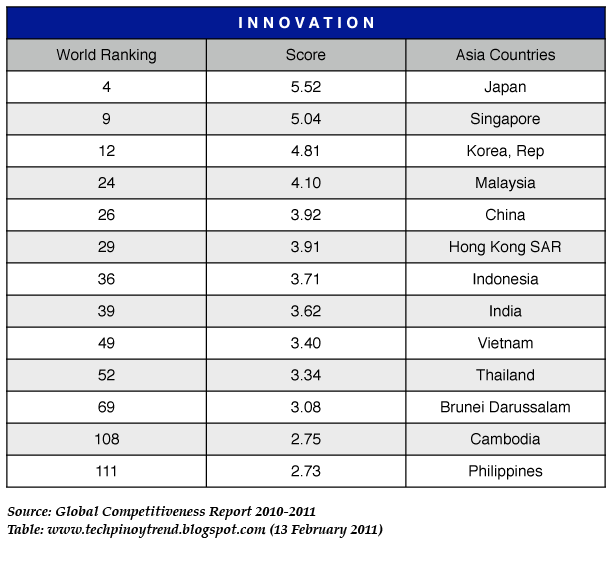
The Philippines continue to fall behind our neighboring countries in terms of Technological Readiness and Innovation based on the Global Competitiveness Report 2010-2011, released during its World Economic Forum in Geneva, Switzerland last year.


According to the index, the country has slipped from rank 99 in 2009 to rank 111 in 2010 under the innovation category, as well as significantly eleven notches lower in terms of technological readiness, from rank 84 in 2009 to rank 95 in 2010. Although, its overall ranking based on the twelve pillars of competitiveness: institutions, infrastructure, macroeconomic environment, health and primary education, higher education and training, goods market efficiency, labor market efficiency, financial market development, technological readiness, market size, business sophistication, and innovation, the country has slightly improved at two notches rank higher at 85 out of 139 countries. In 2009, the Philippines ranked 87 out of 133 countries.


Its Southeast Asian counterparts - Singapore, Malaysia, Brunei Darussalam, Thailand, Indonesia, Vietnam and Cambodia, have fair improvements, as well as declines in both categories albeit significantly ranked higher than the Philippines. It is only in the category of technological readiness, where the Philippines is twenty notches higher than Cambodia. However, among its Southeast Asia neighbors, it was Brunei Darussalam who has significantly improved in both categories. It has climbed eleven notches from rank 60 in 2009 to rank 49 in 2010 in terms of technological readiness as well as improvements in the innovation, which is also significant at rank 75 in 2009 to rank 69 in 2010.


The variables considered in the technological readiness are the countryʼs technological adoption, i.e. the availability of latest technologies, firm-level technology absorption, FDI or foreign direct investment, and technology transfer. Also included under the said category is the countryʼs position in terms of Information and Communication Technology, i.e. the number of internet users, broadband internet subscriptions, and improvements on the internet bandwidth. On the other hand, variables in the innovation category are based on the capacity of the country to innovate, which includes the quality of scientific research institutions, company spending on R&D, university-industry collaboration, government procurement of advanced technological products, availability of scientists and engineers, and the utility patents per million population.


Published annually by the World Economic Forum (WEF), the Global Competitiveness Report 2010-2011 seeks to measure and compare the competitiveness level of 139 countries worldwide. The WEF defines competitiveness as the set of institutions, policies and factors that determine the level of productivity in a country. This definition forms the basis of a comprehensive framework comprised of key constructs commonly referred to as the 12 pillars of competitiveness. The weighted aggregate of these 12 pillars constitute the Global Competitiveness Index (GCI), which in turn is used to measure the performance of each country. The GCI score has a minimum value of 1 and a maximum of 7. Countries are then ranked based on these scores, where higher scores are accorded higher rankings.