The Global Competitiveness Report, developed for the World Economic Forum (WEF) is based on the latest theoretical and empirical research where two thirds come from the Executive Opinion Survey (EOS) and one third comes from the publicly available sources such as the United Nations. These gathered informations account for more than 90 variables and was completed by over 13,500 business leaders from the featured 139 economies. In the Philippines, WEFʼs partner institute is the Makati Business Club (MBC) in association with the Management Association of the Philippines (MAP) who provides the qualitative assessment on the competitiveness of the country.
Compared to 2009-2010 performance, the Philippines is slightly two places better from 87th to 85th in the Global Competitiveness Report 2010-2011 rankings. Of the twelve pillars, five exhibited improvements in rankings and seven declined (See Table 1). Included in the said declines are the technological readiness and innovation of the country.
The positive outcome of the Philippines according to the report was in the area of Financial Market Development, with a rank of 75th (or an improvement of +18 places), over 2009-10. This is primarily due to the countryʼs soundness of banks and the availability of financial services, where the executives registered a higher score by 5.57 and 5.06 respectively.
 |
| Table 1 |
As mentioned, the Technological Readiness and Innovation categories shown in Table 2, were among the seven pillars that have respective declines of -11 places (from 84th to 95th) and -12 (from 99th to 111th). Slight improvement among the sub-categories of technological readiness is in the broadband internet subscriptions which demonstrated an increase of +5 places (from 89th to 84th). However, there are significant reductions of -5, -5, -16 and -6 in the areas of availability of latest technologies, firm-level technology absorption, FDI and technology transfer, and internet users, respectively.
The 12-place reduction in rankings for Innovation was largely due to the significant deterioration in key areas. In particular, company spending on R&D (-24 places), government procurement of advance technology products (-10 places), and quality of scientific research institutions (-6 places). Marginal decline is in the availability of scientists and engineers of -1 place (from 95th to 96th), in which the countryʼs current stand is at 165 R&D personnel per million Filipinos which is way below the UNESCO recommendation of 380 needed for economic development according to the Department of Science and Technology (DOST) report. Showed increase are in the number of utility patents, which improved by +7 places (from 78th to 71st) and in the university-industry collaboration in R&D by +4 places (from 89th to 85th).
 |
| Table 2 |
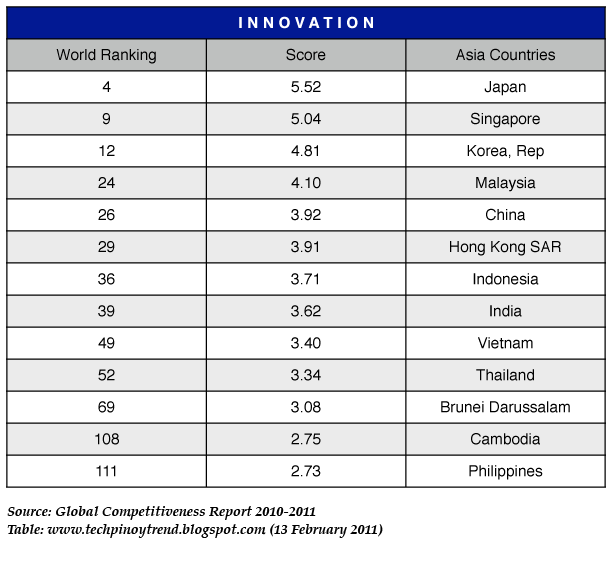
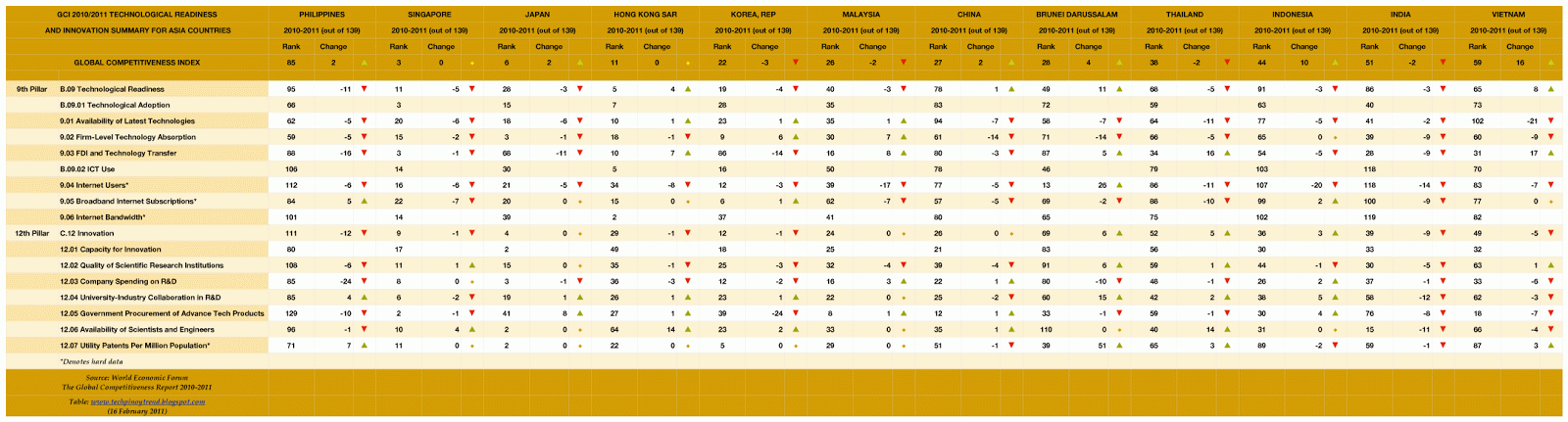
Highlighted in Table 3 is the summary of GCI performance in terms of Technological Readiness and Innovation of the twelve countries who participated in the GCR 2010-2011. Compared to its regional counterparts, the Philippines ranked 12th and one of the four countries that registered a reduction in both categories. Noted improvements in the technological readiness are Hong Kong SAR (+4 places), China (+1 place), Brunei Darussalam (+11 places), and Vietnam (+8 places). On the other hand, significant improvements in the innovation categories are countries of Brunei Darussalam (+6 places), Thailand (+5 places), and Indonesia (+3 places). Of the twelve countries, noted increase in both categories is Brunei Darussalam. Although, based in the GCI overall ranking of 139 economies, Singapore is still ahead (3rd place), followed by Japan (6th place), and Hong Kong SAR (11th place).
 |
| Table 3 |
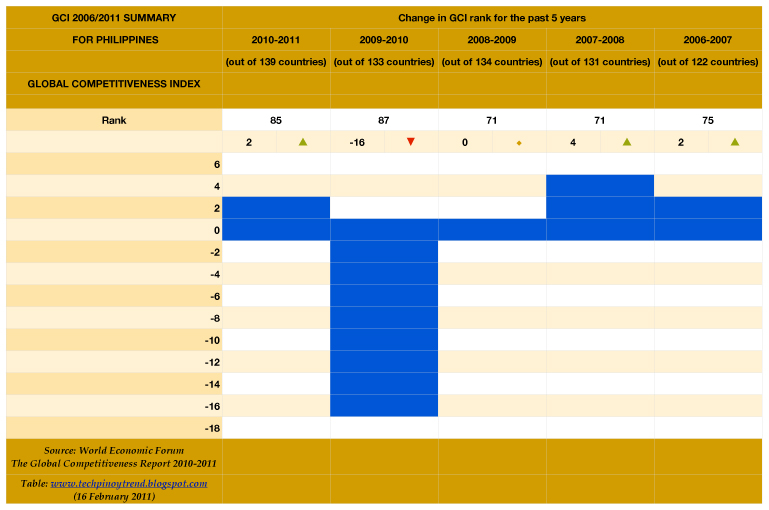
Presented in Table 4 is the change of the GCI ranking for the past 5 years and the Philippines has notably experienced a deep decline of -16 places, from rank 71st in 2008-09 to 87th in 2009-10. Some of the factors that have affected its decline were due to the global economic recession followed by issues on corruption pertaining to the infrastructure projects of the Arroyo administration, i.e. the controversial National Broadband Network and the Northrail projects. The countryʼs Foreign Direct Investments were also affected due to the transfer of its companies to neighboring countries such as China. Low profitability and slow market demand have led to closure of semiconductor plant Intel Corporation in Cavite as well as US delivery giant FedEx in Subic last 2009.
Currently, the Philippines has made its improvements in ranking of +2 places (from 87th to 85th), due to the strong business confidence and the peopleʼs faith to its new administration. Perhaps, with the implementation of the policies of the Aquino government against corruption, the image of the Philippines will improve as well as the budget support in science and technology, may help continue its trend into the positive quadrant.
References:
The Global Competitiveness Report 2010-2011
The Global Competitiveness Report 2009-2010
 |
| Table 4 |
References:
The Global Competitiveness Report 2010-2011
The Global Competitiveness Report 2009-2010